



Muhd Ibnur Rashad
Class of 2011
Faculty of Engineering
University Scholars Programme
NUS Overseas Colleges
Muhd Ibnur Rashad honed his skills among the best in Engineering at the National University of Singapore (NUS). The dedicated humanitarian and teammates at NUS went on to win global competitions for novel concepts aimed at helping the poor. Upon graduation, Ibnur co-founded the Sustainable Living Lab, a community of creators focused on developing sustainable products, such as the popular iBam 2, the world’s first compact electricity-free bamboo speaker for phones. At NUS, we believe that your ideas can be nurtured into real world success.
A Family Trait
Engineering runs in the family – both my parents are engineers and even my grandfather installed a generator for his kampung and repaired things. Spending time together is very important to my family and these moments gave me a chance to observe and learn from my parents and grandparents. Growing up, I saw how my family did things with a spirit of enterprise – repairing things that are damaged, collecting things that were thrown away by others and upcycling them, making and selling things.
From Science to Sustainability
My passion began with science – seeing how things work, discovering nature, understanding physics. I then started to question if all that knowledge could be used for a good purpose, and that’s when my interest in sustainability began to develop.
I first applied to study medicine at NUS, but didn’t get in. This event made me seek out other ways to contribute to society. I then came across the Engineering Science Programme (ESP), which allowed me to be at the frontiers of research, combining both my interests in science and engineering.
Engineering Science Programme
The Engineering Science Programme (ESP) is an intensive course with a small cohort of only 40 students. As an ESP undergraduate, you need to understand the underlying scientific principles of various emerging technologies, and through hands-on design projects, you are expected to be innovative and translate scientific ideas into reality.
University Scholars Programme & NUS Overseas Colleges
Where can I find another university that allows an engineer to be in an interdisciplinary academic programme (USP) and go off to another country to learn entrepreneurship (NOC)?
One of the draws of NUS, to me, was the University Scholars Programme (USP), which is multidisciplinary and broadens your horizons. In USP, you have to be critical, analytical, do your research and read widely − in that sense, it allows you challenge yourself to explore new grounds.
With NOC, I got to experience Silicon Valley first hand. I got to learn the garage entrepreneurial culture, which you can only do if you live within it. I made global connections and had unique opportunities.
What I’m Doing Now
I was approached by Google to work in Silicon Valley, but I wanted to return to Singapore and contribute to my homeland. For me, it is important to do something in line with my own set of values and the spirit of enterprise. Right now, I’m primarily involved in 3 core initiatives:
Sustainable Living Lab (SL2)
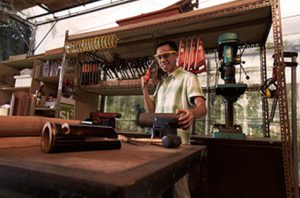
The Sustainable Living Lab (SL2) is a tech-driven social enterprise striving to “redefine the way we make”. It operates a semi-outdoor community prototyping space connected to a village of makers. The laboratory is based in Bottle Tree Park at the Sustainable Living Kampung. It is a space where anyone can come to make solutions that are sustainable, serving a humanitarian purpose. As one of the co-founders, I seek to grow the village of makers − innovators, designers, inventors, essentially people who want to use their hands to do something and make a difference.
An beautiful example of a sustainable solution designed out of SL2 is the iBam 2 - the world's first compact electricity-free bamboo speaker for your smartphone
Humanitarian Engineering Alliance (HEAL)
The Humanitarian Engineering Alliance (HEAL) is a consortium of NGOs, engineering professionals and educational institutions under the Institution of Engineers, Singapore (IES). It aims to address humanitarian issues, for example, how engineering can be used to fight poverty, help a community to recover from a disaster and develop a slum area or village.
HEAL strives to work alongside humanitarian NGOs (such as World Vision International and Save the Children International) as well as the Singapore Civil Defence Force towards growing the humanitarian engineering sector and to scope the needs and gaps of the humanitarian sector. In 2013, HEAL will be organizing the HEAL Conference in conjunction with the World Engineer’s Summit, in which engineering organisations from around the world will be coming to Singapore to chart the future of the global engineering sector.
Ground-up Initiative (GUI)
Ground-Up Initiative (GUI) is a volunteer-driven non-profit community that seeks to restore the connection between city dwellers and the land for the many universal values and life skills it teaches us. As more than half the world’s population live in cities, it is becoming more important than ever to keep our basic connection with the land alive. To bridge this connection, GUI has been shaping a Sustainable Living Kampung (SL Kampung) in Bottle Tree Park, Yishun, encouraging projects and challenges that cultivate a practical environmental awareness.