

Molecular Courtship
Introduction
Introduction
NOTE: Students who had taken UPC2201 Chemicals and Us in or before AY2011-2 are not eligible to read this module.
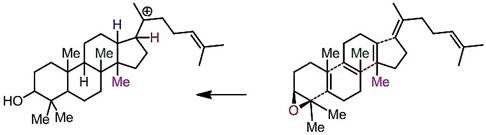
Whether it is a simple acid-base neutralization reaction or a complex series of reactions in the biosynthesis of cholesterol, the initiation of any reaction is the interaction between two separate reacting species or two separate reacting sites in a molecule. The interaction is molecular courtship similar to human courtship, i.e. between two species or two sites of opposite nature. This molecular courtship can stay in close proximity for a long time, or it can result in molecular marriage, i.e. forming a bond. On the contrary if conditions turn out to be unfavorable, the courtship may terminate or the marriage may end with a divorce.
Acid-base neutralization: H + + OH ‒ → H2O
|
Sequence of concerted reactions in the biosynthesis of cholesterol |
If the molecular courtship is favorable, it governs the resulting combined properties of the two interacting species, quite similar to human courtship moderating the human behavior of the individuals and promoting mutual understanding.
Module Description
Module Description
How does an understanding of molecular interactions help us to make sense of everyday chemical phenomena to important chemical technologies? For example why are plastics non-biodegradable? Why and how an LED lights up or gets quenched, or one drug molecule works while another results in side effects? These are important outcomes resulting directly or indirectly from initial intermolecular forces. Environmental issues such as differentiation between biodegradable and "unfriendly" materials can also be discussed. Stereochemical or 3D-controlled intermolecular forces allow an understanding of many chemical processes in biological systems.
Learning Outcomes
Learning Outcomes
Students will gain general and technical understanding that allows explanation or prediction of the chemical behaviour and properties of materials and bioactive compounds. These include academic examples that could be extended to longstanding and current worldwide chemical issues such as why are many plastics non-biodegradable, mechanism of toxicity of dioxins in the 2011 Dioxin Threat in Europe and why and how the key step in mad-cow disease develops.
One of the USP emphases is on broad-based, interdisciplinary learning with good appreciation and understanding. This module (chemistry-oriented) parks under the Sciences and Technologies Domain and complements the existing module Chemical and Us (more chemical engineering-oriented) under Physical and Chemical Technologies.
Rationale for Introducing This Module
Rationale for Introducing This Module
It is a challenge to design a chemistry-based First-Tier module with significant technical content that is readily readable and appreciated by non-science (and non-engineering) students.
In the design of this module one relatively simple set of fundamental principles that could be learned by students from all walks of life is selected as the basis of general and technical understanding. This is then extended to include broad-based, interesting, current and important chemical and biochemical aspects in materials and medicinal chemistry. Direct overlap of topics and examples covered in this module with any NUS module is at minimum. The module covers significant non-textbook materials that are not covered in modules offered in other Departments/Faculties.
Reference
Reference
Books
- Hill, J. W.; McCreary, T. W.; Kolb, D. K. Chemistry for Changing Times, Pearson, 2009.
- American Chemical Society, Chemistry in Context, McGraw Hill, 2009.
- Patrick, G. L. An Introduction to Medicinal Chemistry, Oxford Press.
Articles
- Chameides, B. When Greenware Breaks Down ... on Its Eco-Friendly Promises, Scientific American, June 2011.
- Biello, D. LED There Be Light, Scientific American, March 2009.
- Swaminathan, N. Scientists Closer to Unfolding Mysteries of PrionFormation in Mad Cow Disease, Scientific American, May 2007.
- Sharpe, L. H. What exactly is the physical or chemical process that makes adhesive tape sticky? Scientific American, July 1997.
- Feldman, M. Drug Discovery Looks for Its Next Fix, http://www.hpcwire.com/hpcwire/2012-07-31/drug_discovery_looks_for_its_next_fix
Syllabus
Syllabus
| Week | |
| 1 & 2 | What is molecular courtship? Does it end in a marriage? Introduction to inductive effect, resonance effect, conjugation effect and intermolecular interactions |
| 3 & 4 | Why do microorganisms lose their war in breaking down plastics? A comparison of the non-polar nature of saturated polymers and the polarized properties of functional polymers. Their biodegradability and the environment. Conjugation effective in organic conducting materials and their sometimes undesirable intermolecular interactions. Conjugation effect and the emission color of polymers. How does intermolecular attraction changes from a curse to a blessing going from graphite to graphene? |
| 5 | Intermolecular interactions in house items: from detergents to hair products to adhesives. |
| 6 | What is the role of intermolecular interactions in worldwide issues such as mad-cow disease, dioxin toxicity, BPA leaching from plastic bottles? |
| 7 | How does 3D framework affects what we smell and taste? From simple stereochemistry to complex stereochemical environment in enzymes and proteins. Chiral recognition as a specific intermolecular interaction. |
| 8 & 9 | How does a drug sit in the right place in our body to carry out its function? An understanding of intermolecular attractions in the docking phenomenon: how simple molecules get trapped in complex proteins. |
| 10 | What is a simplified picture to show the breaking down of meat we consumed into smaller molecules our body could absorb? The push-and-pull intramolecular attractions in catalytic traids: an effective system in breaking large proteins to smaller peptides. |
| 11 | How does penicillin continues to win the war against bacteria after all these years? The penicillin family: role of intermolecular forces in drug design and modification. |
| 12 & 13 | Selected topics in student projects presented by students. |
Assessment
Assessment
Quizzes, tests and final examination will be designed for open-book exercises where the questions set are employed to test the students'understanding, thinking process and application of concepts and knowledge. Quiz-Test-Examination conducted in that order will provide students one (of several) indication of their learning progress. The questions in each paper will be developed with questions bearing different level of difficulty although such information was not indicated to the students.
Independent project-based learning will be introduced. This will give the class a wider learning spectrum on related aspects of the module content. Students propose their project topics on basis of key fundamental concepts introduced in the lecture series. This will allow direct application of what they learn in class to areas of their interest. Topic and main content will be vetted before students (in pairs) work on a written essay. Students will give a 20-25 min presentation on each project. Questions will be posted by both the lecturer and student peer assessors after the presentation. The questions posted by the peer assessors will be assessed by the lecturer. Thus peer assessors will have to learn how to do a good and fair job by reviewing the report carefully and be attentive at the presentation. In the process they will learn the content of the reports well.
The approach is planned with fairness in mind. In addition to the lecturer's grading, formal (counting toward final score) written peer assessment on both the report and presentation of other students will be introduced. This approach will be relatively effective. Through formal peer assessment students expand their learning spectrum in greater details while building confidence in honest analysis and comments. Student assessors are assessed by the lecturer in their peer assessment report. Again they will be careful in their review and learn the content well.